Originally published on LinkedIn.
Over the past decade, since the arrival of BERT-like models in 2018–2019, I have closely followed the evolution of AI frameworks, model architectures, and the underlying hardware that enables them. During that time, concerns about an impending “AI bubble” have surfaced more than once, often contradicting my conviction that AI represents one of the most transformative forces in modern history. In the following analysis, I argue that from 2026 to 2030, we are entering AI’s golden era — and that the notion of an AI collapse stems largely from cognitive biases and resistance to adaptation.
AI Capex at record high but at fair value
From a financial perspective, the surge in AI investment has been unprecedented. Many critics claim this enthusiasm mirrors past tech manias, with corporations jumping onto the AI bandwagon simply because it’s fashionable. While it’s true that global AI-related capital expenditure (CapEx) has reached record levels, the scale and maturity of today’s market make this expansion more sustainable than during previous bubbles such as the dotcom era.
AI requires uniquely capital-intensive infrastructure — particularly GPUs that can now cost upwards of $50,000 each — and such barriers naturally act as a moat that limits participation to serious players with deep pockets and strategic direction. Unlike past technology waves such as IoT, Big Data, or Cybersecurity, the AI sector demands costly computational resources and world-class research talent. This dynamic explains why valuations remain relatively rational and concentrated around major firms like OpenAI , Anthropic , Alibaba Group , and Tencent . In essence, today’s high CapEx reflects a fair investment in assets with measurable returns and long-term utility.
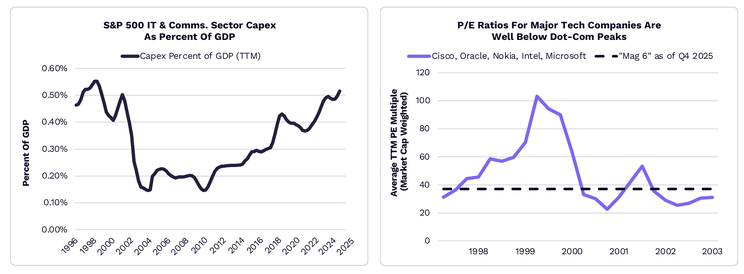
S&P500 IT Capex as % of GDP against IT P/E ratios
The U.S. and China: The New Tech Arms Race
Geopolitically, the ongoing technological competition between the United States and China ensures that AI’s momentum will not be easily disrupted. While economic cycles may introduce temporary liquidity shocks — as seen in early 2026 — neither nation can afford to cede dominance in artificial intelligence.
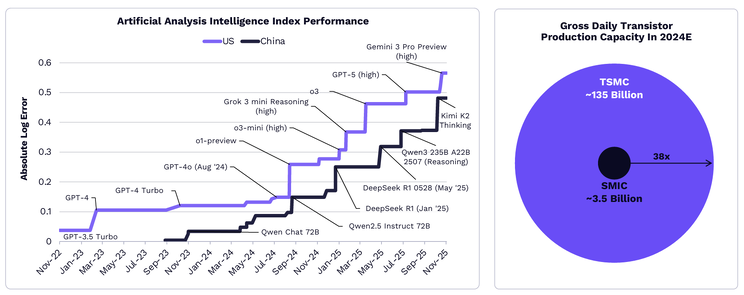
Artificial Analysis benchmark US vs. China models and TSMC vs SMIC production
Despite U.S. restrictions on GPU exports and pressure on companies like TSMC and ASML , Chinese frontier models remain only six months behind U.S. benchmarks. Initiatives such as SMIC’s domestic chip production underscore China’s determination to achieve self-sufficiency. This strategic rivalry effectively guarantees continued investment and innovation, as both countries recognize that leadership in AI equates to geopolitical leverage. In this context, even monetary tightening or short-term recessions are unlikely to derail the core trajectory of AI advancement.
The Next Paradigm Shifts: Quantum and Digital Currencies
We already have mentioned a black swan event as a thread to dilute the AI as the main game in the technology domain. Going back in time, the last black swan event was the COVID-19 crisis. We all remember the main media reporting a V-shape fast recovery in which, this time, we would not suffer the long term period of economic harsh such as in the 2008 sub-prime crisis. Having the coordination of the central banks around the world to massively inject liquidity in the financial veins of the world economy certainly was necessary to avoid the world be submerged in a decade of misery. The recover itself was not V-shaped but K-shaped and the effects of such a huge injection of liquidity would generate an aftermath of inflation that would serve states to monetise public debt but create poverty for people. Here what we mostly forgot is that the technological shift was investing in Big Data technologies such as Data Mesh, Data Catalogs, Compute-storage detached PaaS clusters to the AI models like decoder only (GPT-2) or encoder only (BERT) models or LLMs and SLMs or diffusion ones for image generation. At that time some companies opted for BERT like solutions to safe money by hiring engineers to deploy a in-house solution but using an OpenAI API with GPT-2 and their subsequent models has been the winning tactic. This time the paradigm shift could come from several topics but these two are on the eyes of most powerful countries:
- Quantum computing as the main game to play between US and China
- The plan to make all payment transactions electronic by using a CBDC (Central Bank Digital Currency)
Quantum computing (QC), despite being the clear next frontier after a AI being able to to mostly replace humans doing full-scale coding and white-collar jobs, is still in its infancy. QC is also a strategic technology that could change the course of the world to whatever country clearly surpasses the rest. The bad news for QC is that there a need of much more road to run in terms of useful algorithms as well as a hardware technology that doesn't scale at a pace that could be a game changer before 2030 and even until 2040 in the best of the scenarios. The chart below is a projection in which if the Moore's law of doubling transistors was translated to useful qubits, then the RSA 2048 algorithm could be cracked by 2044, which would create a paradigm shift that would force a major change in the state of the art of the Internet in terms of cybersecurity.
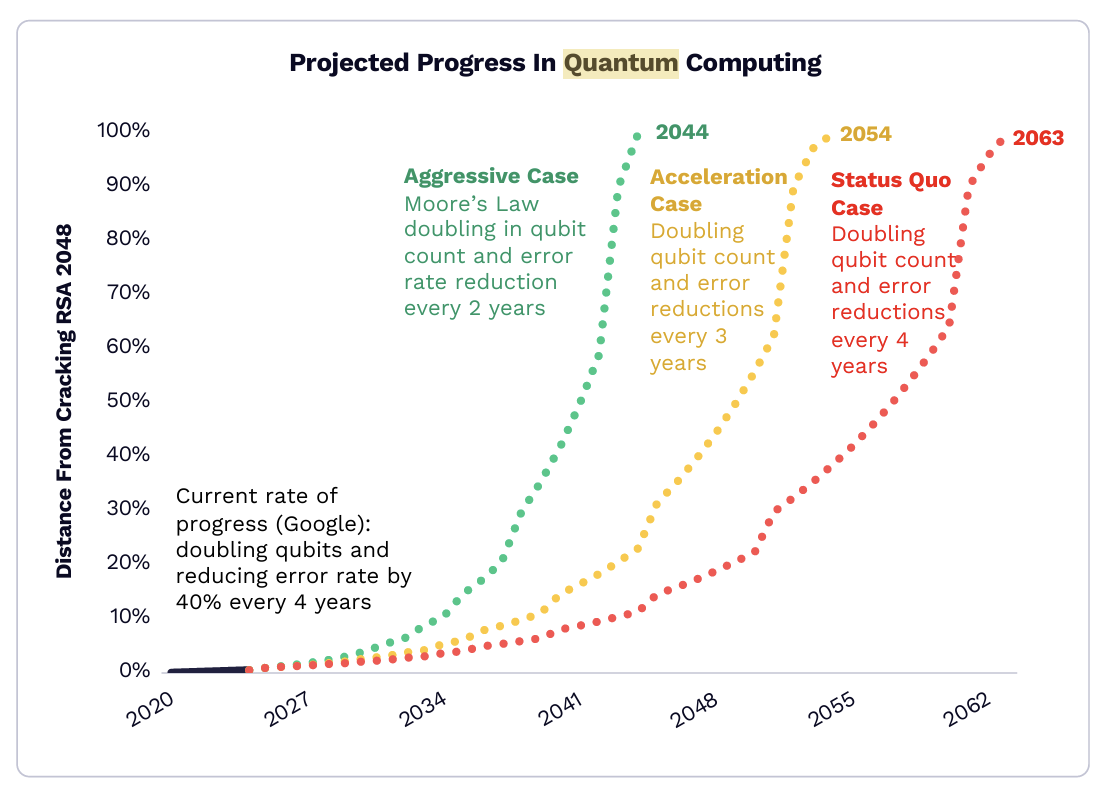
Projections for Quantum Computing breaking RSA 2048
The CBDC rollout is the major economic initiative in the world nowadays from central banks to transition from physical money to electronic money in a centralised way before any distributed alternative could become viral among populations and become a strong option. In this case we are not talking only about nations trying to obtain the global seigniorage of the currency, which is now mostly on the US with the Petrodollar paradigm, but we are also talking about a coordinated effort (pandemic-liked) among all central banks to make a local rollout before 2030 where tax authorities will have a much more precise way to track citizens. This can become a real stop for AI as all the attention will turn to finance what will be the most financial paradigm shift since the central banking model. Being in the agenda of institutions, the transition is going to happen for sure and the dates are already fixed by central banks. The good news is that AI can go ahead for around 4 years more as the central banks have all agreed to do it near the end of the decade, on 2030.
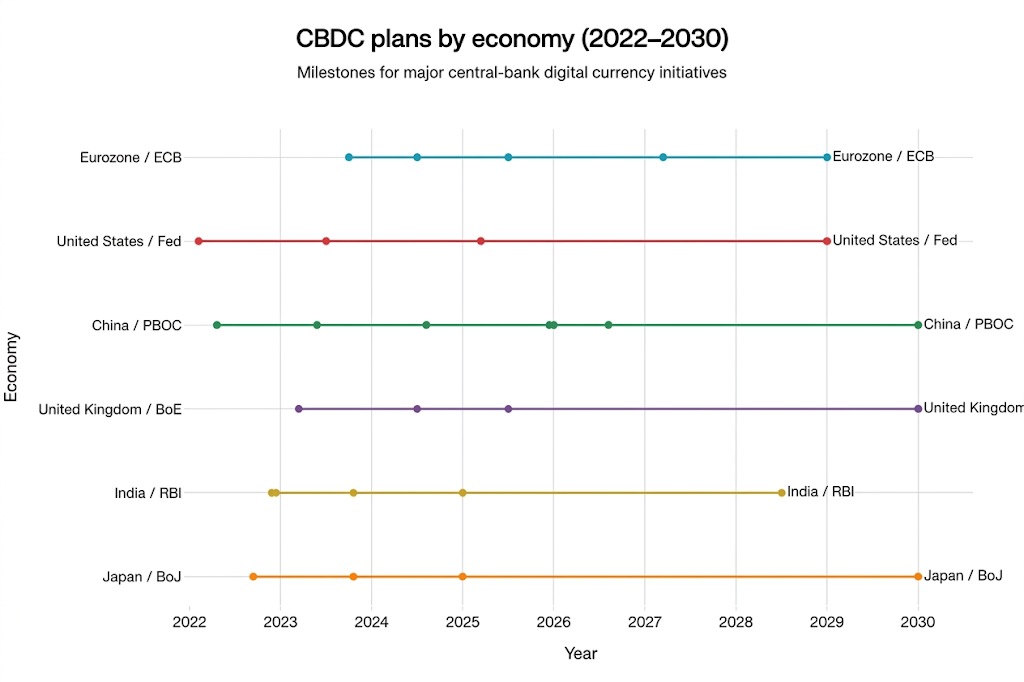
Central banks CBDC rollout agendas
Outlook: The Road Ahead
The period between 2026 and 2027 will likely bring renewed liquidity pressures as around $33 trillion in debt from pandemic-era needs to be rolled over, sparking short-term uncertainty and speculation about the sustainability of the AI economy. Yet, the geopolitical imperative for leadership in AI — particularly between the United States and China — ensures that research, deployment, and adoption will continue to accelerate.
Companies will have the next 5 years to adopt AI to make as much work from white collar jobs as possible. Then, a paradigm shift in 2029-2030 will likely to be the catalyst of some financial black swan related to central banks implementation of CBDCs all around the world. That final hit will also very likely be accompanied again by liquidity tensions, that will be the shadow of what was somehow patched during 2026-2027 but this time with a bigger principal.
In summary, far from being a speculative bubble, AI’s current expansion represents a structural shift supported by global capital, strategic necessity, and technological momentum.
Sources: ARK Investment Management LLC
Federal Reserve System BIS Cross Border Capital
Images generated with: Gemini and Perplexity and from ARK